It was March 2020. The Nifty had just crashed 38% in a month. My portfolio was bleeding. And I was sitting at my desk, staring at my screen, completely paralyzed.
Here’s what I remember thinking: I’ll wait. I’ll wait until it feels safe again.
I waited. The market recovered. And I missed the single greatest buying opportunity of the decade — not because I was broke, not because I didn’t know what to buy — but because I had no system. I was making emotional decisions in real time, and emotions are the worst portfolio managers in the world.
That year changed how I invest forever. I stopped trusting my gut and started trusting a process. And the core of that process? Automated portfolio rebalancing.
If you’ve never heard of it, or if you think it’s something only big institutions do, stay with me. Because by the end of this, you’re going to realize that not using it has probably already cost you money — and you didn’t even notice.


What Most Indian Investors Actually Do (And Why It Quietly Destroys Returns)
Let me paint you a picture. You invest ₹10 lakhs. You split it 60% equity, 40% debt. You feel balanced. Smart. Diversified. You pat yourself on the back and go back to your life.
Fast forward 18 months. The Nifty has gone up 40%. Suddenly, without you doing anything, your portfolio is 72% equity and 28% debt. The balance you carefully designed? Gone. Silently. Without a single alert.
This is what I call drift. And drift is expensive.
Most investors in India don’t check their allocation more than once a year, if that. They look at returns, feel good or bad, and move on. But returns without allocation awareness is like driving on a highway while only watching the speedometer and ignoring the steering wheel.
The truth is, most people think rebalancing means “sell the losers and buy the winners.” That instinct is wrong, and I’ll explain exactly why it’s wrong a little later. But the deeper problem is that most people don’t rebalance at all — not manually, and certainly not automatically.
And so portfolios drift. Risk increases silently. And when the correction finally comes — like it did in 2020, like it did in 2015, like it always does eventually — they’re overexposed in exactly the wrong place at exactly the wrong time.
The Moment I Actually Understood Automated Portfolio Rebalancing
I’ll be honest — I first heard about automated portfolio rebalancing from a fund manager friend over coffee, and I dismissed it. “That’s for large HNI portfolios,” I said. “My ₹25 lakh portfolio doesn’t need that level of complexity.”
He laughed. Not in a condescending way. Just the laugh of someone who’s heard that line a hundred times.
“Rebalancing isn’t about complexity,” he said. “It’s about removing yourself from the equation.”
That hit differently.
He showed me a simple backtest on a Nifty 50 + Nifty Debt index portfolio from 2010 to 2023. Two scenarios. Portfolio A: set and forget. Portfolio B: automated portfolio rebalancing every 12 months back to 60/40.
Portfolio B outperformed Portfolio A by roughly 1.8% CAGR over 13 years. That doesn’t sound like much. But on ₹25 lakhs over 13 years? That’s the difference between ₹98 lakhs and ₹1.18 crores. Same starting capital. Same asset classes. The only difference was the system.
I stopped dismissing it after that conversation.
How Automated Portfolio Rebalancing Actually Works
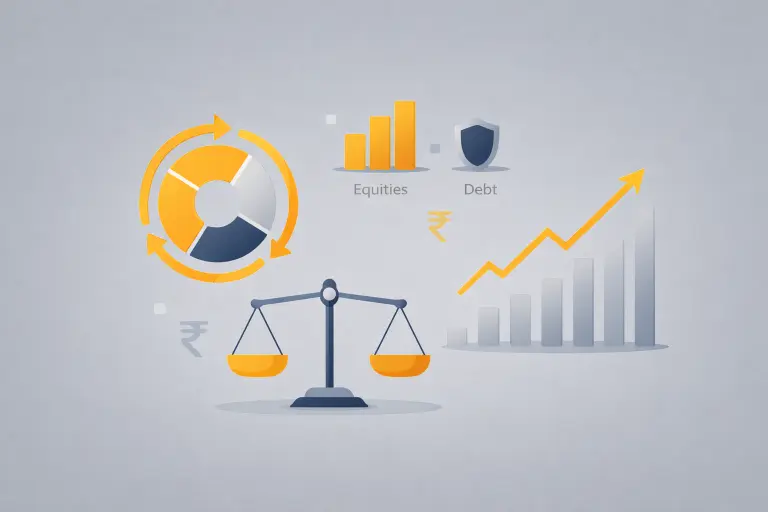
Automated portfolio rebalancing is the process of automatically bringing your portfolio back to its target asset allocation at defined intervals or when the drift crosses a set threshold — without you having to manually decide, calculate, or execute anything.
Think of your portfolio like a garden. You plant it in a specific arrangement. But over time, some plants grow faster and crowd out the others. Rebalancing is the pruning. Automated rebalancing means the gardener shows up on a schedule, without you having to remember to call them.
There are two main methods:
- Calendar-based rebalancing: You rebalance on a fixed schedule — quarterly, semi-annually, or annually. Simple. Predictable. Easy to automate.
- Threshold-based rebalancing: You set a drift limit, say ±5% from target. If equity drifts above 65% in a 60/40 portfolio, the system auto-corrects. More precise, slightly more complex to set up.
Some platforms now combine both — they check on a schedule and only execute if drift exceeds the threshold. That’s the most efficient approach, and it reduces unnecessary transactions.
In the Indian context, automated portfolio rebalancing is available through select platforms and fintech tools. One tool that’s gaining traction among serious Indian investors is Goela AI, which brings AI-driven intelligence to portfolio tracking and rebalancing decisions. It’s built for the Indian market, which matters more than people realize — because SEBI regulations, STT, and LTCG tax rules change the math compared to Western models.
The execution itself typically involves selling the over-weighted asset class and buying the under-weighted one. For example, if equity has drifted from 60% to 70%, the system sells equity units worth 10% of the portfolio and moves that into debt. Clean. Unemotional. Systematic.
The Tax Reality Nobody Talks About Clearly
Here’s where most blog posts about automated portfolio rebalancing wave their hands and move on. I’m not going to do that, because taxes in India can significantly affect whether rebalancing helps or hurts you in the short term.
Every time you rebalance by selling equity, you’re potentially triggering a taxable event. If you’ve held equity mutual funds or ETFs for more than 12 months, gains above ₹1 lakh are taxed at 10% LTCG. Under 12 months, it’s 15% STCG. Debt fund gains are taxed at your income slab rate after the 2023 budget changes.
So does this mean you shouldn’t rebalance? No. It means you should rebalance smartly.
A few strategies that actually work in the Indian context:
- Rebalance using new contributions: Instead of selling, direct new SIP or lump sum money into the underweight asset class. This avoids triggering gains entirely.
- Use tax-loss harvesting: If some holdings are in loss, sell those first. Offset gains with losses within the same financial year.
- Rebalance inside ULIP or NPS: Both allow switches between asset classes with no immediate tax impact. Hugely underused for this purpose.
- Time your rebalance to LTCG thresholds: Wait until equity holdings cross the 12-month mark before triggering the rebalance sell. A good rebalancing tool will track this for you automatically.
The math still works in rebalancing’s favor even after taxes, especially over 10+ year horizons. But the approach matters. Blind automation without tax awareness can be costly. Smart automation — the kind a quality rebalancing tool provides — accounts for this.
Myth-Busting: Two Things Most People Get Wrong About Automated Portfolio Rebalancing
Myth 1: “Rebalancing means selling winners and buying losers — that’s stupid.”
I hear this one constantly. And I understand the intuition. Why would you sell your Nifty 50 ETF that’s up 45% and buy more of your debt fund that returned 7%? It feels like punishing success.
But this framing misses the entire point.
You’re not selling because equity is bad. You’re selling because equity now represents more risk than you originally signed up for. Your 60/40 portfolio is now a 72/28 portfolio. That extra risk isn’t free — it increases your drawdown in a crash, disrupts your sleep, and often leads to panic selling at the worst moment.
Automated portfolio rebalancing is not about chasing performance. It’s about staying true to your risk tolerance. It forces you to buy low and sell high systematically — not emotionally. And that discipline, over 15-20 years, compounds in ways that feel magical but are entirely mechanical.
The data backs this up. Vanguard’s research showed that a rebalanced 60/40 portfolio had a maximum drawdown roughly 5-7% lower than a drifted portfolio during major market downturns. Lower drawdown means less panic. Less panic means you stay invested. Staying invested is 80% of the battle.
Myth 2: “I’ll just rebalance manually when I feel the time is right.”
This one is more dangerous because it sounds reasonable.
I tried this approach for three years. You know what I found? I never felt like the time was right. When markets were rising, I didn’t want to sell equity — it felt like leaving money on the table. When markets fell, I was too afraid to buy equity — it felt like catching a falling knife.
So I did nothing. For three years. And my portfolio drifted from 60/40 to nearly 80/20 equity by late 2021. Then 2022 happened. My portfolio fell almost twice as much as it should have given my intended risk profile.
That’s the real cost of manual, feel-based rebalancing. You think you’re being smart and strategic. But you’re actually just letting emotions quietly sabotage your allocation without realizing it. Automated portfolio rebalancing removes “the right time” from the equation entirely. And that’s the point.
Practical Action Steps: How to Start Automated Portfolio Rebalancing in India
Enough theory. Here’s what you should actually do.
- Define your target allocation first. Before any automation, get clear on your numbers. A 30-year-old with stable income might do 80% equity, 20% debt. A 50-year-old nearing retirement might prefer 50/50. Write this down. Make it official. This is your portfolio’s constitution — everything else follows from it. Don’t pick a number because someone on YouTube said so. Pick one you can genuinely hold through a 30% market crash without panic selling.
- Choose the right tool and set your rebalancing rules. For most retail Indian investors, the simplest entry point is through direct mutual fund platforms that offer automatic rebalancing features, or through a dedicated rebalancing tool that integrates with your holdings across brokers. Set a threshold of ±5% drift, combined with an annual calendar review. This gives you precision without over-trading. If you want AI-driven portfolio intelligence specifically built for Indian markets, explore platforms like Goela AI that can give you data-driven signals beyond just allocation drift.
- Automate contributions before you automate sells. The most tax-efficient form of automated portfolio rebalancing starts with directing new money — SIPs, bonuses, salary increments — into the underweighted asset class first. Set up separate SIPs for equity and debt that are reviewed semi-annually. Only trigger sell-based rebalancing when contributions alone can’t correct the drift within a reasonable timeframe. This one habit alone can save you thousands in taxes every year while keeping your allocation on track.
Frequently Asked Questions
How often should I do automated portfolio rebalancing in India?
For most retail investors, annual rebalancing combined with a 5% drift threshold is the optimal approach. Rebalancing too frequently — say, monthly — increases transaction costs and tax events without meaningfully improving returns. Research across various market cycles suggests that annual or semi-annual rebalancing captures most of the benefit. The key is consistency, not frequency. If you’re using a proper rebalancing tool, it will monitor drift continuously and alert you or execute only when the threshold is breached, making the timing decision automatic.
Does automated portfolio rebalancing work for SIP investors with smaller portfolios?
Automated portfolio rebalancing is arguably more valuable for smaller portfolios because it enforces discipline at a stage when behavioral mistakes are most costly. You don’t need ₹1 crore to benefit from it. If you have two or more mutual funds — say, a Nifty 50 index fund and a short-duration debt fund — you can practice rebalancing by adjusting SIP amounts semi-annually based on which allocation is underweight. Even this manual-but-systematic approach delivers most of the behavioral and return benefits of full automation.
What is the biggest risk of automated portfolio rebalancing?
The biggest risk is blind automation without accounting for taxes and transaction costs. If a system sells equity every time there’s a 2% drift, you’ll generate frequent STCG tax events and brokerage costs that erode any rebalancing benefit. The second risk is rebalancing based on a wrong target allocation — one that doesn’t reflect your actual risk capacity. Automation amplifies whatever rules you set, good or bad. So get your allocation right first, set a sensible threshold (5% is the standard), and ensure your tool accounts for Indian tax rules before executing.
The Portfolio That Takes Care of Itself
I think about the version of me sitting frozen in March 2020, watching the Nifty collapse and doing nothing. Not because I was lazy. Because I had no system. Every decision required emotional energy I didn’t have.
Automated portfolio rebalancing didn’t just improve my returns. It reduced the mental load of investing to almost zero. My portfolio now has a job description. It knows what it’s supposed to look like. And when it drifts from that description — because markets always drift — it corrects itself, with or without my involvement.
That’s not passive investing. That’s intelligent investing.
The investors who build real wealth over decades aren’t the ones who make the best calls. They’re the ones who build the best systems and then get out of the way. Automated portfolio rebalancing is one of the most powerful, most underused systems available to every Indian investor today — regardless of portfolio size, regardless of market conditions.
You don’t need to time the market. You need a portfolio that rebalances while you sleep.
The best investing decision you’ll ever make isn’t a stock pick — it’s the system you build to make sure you never have to make a panicked decision again.