I remember the day clearly. It was a Tuesday afternoon, Nifty was choppy, and I was staring at my screen watching Tata Motors. The LTP showed ₹480. I had done my analysis, felt confident, and placed a buy order at ₹480. Simple enough, right?
The order didn’t execute. By the time it did — after I panicked and revised the price — I had bought at ₹483.50. The stock moved up slightly, then reversed. I exited at ₹479. A loss. Not catastrophic, but completely avoidable. And the worst part? I didn’t even understand why it happened. I thought I understood LTP in stock market. I didn’t.
That mistake sent me down a rabbit hole. I started studying how prices actually work on NSE and BSE, what LTP really represents, and why so many retail investors treat it like a guarantee when it’s really just a snapshot. If you’re new to investing or trading, this is the one concept that looks simple but hides a lot beneath the surface. Let me walk you through it the way I wish someone had walked me through it.
So, What Is LTP in Stock Market? (The Real Answer)
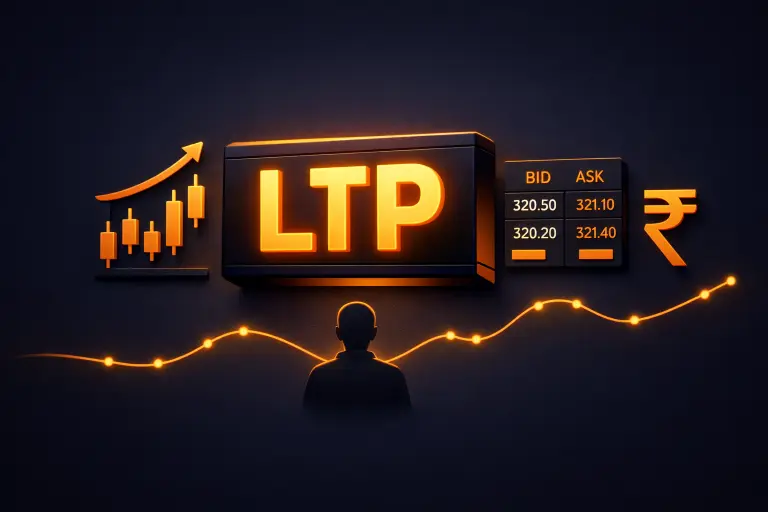
LTP stands for Last Traded Price. It is the price at which the most recent transaction for a stock was completed on the exchange — whether NSE or BSE. That’s it. One trade happened. Someone bought, someone sold, they agreed on a price. That price is now the LTP.
Here’s the thing though — that trade could have happened 3 seconds ago, or in a slow-moving mid-cap stock, it could have happened 4 minutes ago. The LTP in stock market doesn’t tell you what price the stock is trading at right now. It tells you what it traded at last. There’s a subtle but critical difference.


Think of it like a property listing in Delhi. You see a flat listed at ₹1.2 crore. But what does that price mean? Was that the last deal that closed in that building 6 months ago? Or did someone just sell yesterday? The listing price looks clean and definitive, but without context, it can mislead you completely. LTP works the same way.
When you open Zerodha, Groww, or any trading app and look at a stock, the big number you see — the one that’s green or red — that’s the LTP in stock market. It updates every time a new trade executes. On liquid stocks like Reliance, Infosys, or HDFC Bank, this happens hundreds of times per second during market hours. On a small-cap stock with low volume, it might barely move for minutes at a time.
LTP Full Form in Stock Market
LTP full form is Last Traded Price. You’ll also see it referred to as the “last price” in some trading terminals. In the NSE market watch interface, LTP is displayed alongside ATP (Average Traded Price), volume, and the bid-ask spread. Each of those numbers tells a different story. LTP just tells you history — the most recent one.
The Moment Everything Changed for Me
After that Tata Motors trade, I started paying attention to two numbers I had been ignoring: the bid price and the ask price.
Here’s what I learned. At any moment in the market, there are two live prices:
- Bid Price: The highest price a buyer is currently willing to pay
- Ask Price (Offer Price): The lowest price a seller is currently willing to accept
The LTP in stock market sits somewhere in the context of these two. But it is not the same as either. When you place a market buy order, you don’t get the LTP — you get the current ask price. If the ask is ₹483.50 and the LTP showing on your screen is ₹480, you just paid ₹3.50 more than you expected. Multiply that across 200 shares and you’ve already lost ₹700 before the stock even moves.
This surprised me. I had been using LTP as if it were the live market price. It’s not. It’s a record of the past. The market doesn’t care about your LTP when it fills your order.
And this is where most beginners make the same mistake I did. They see the LTP, assume that’s what they’ll pay, and then wonder why their average buy price looks different. The gap between LTP and actual execution price is called slippage — and understanding it is the difference between a profitable trader and a confused one.
How LTP Actually Works on NSE and BSE
Let’s get into the mechanics, but in plain language. When you’re looking at a stock on NSE, every trade that executes goes through the order matching engine. Two parties — one buyer, one seller — agree on a price. The moment that trade settles, that price becomes the new LTP in stock market.
This happens continuously during market hours (9:15 AM to 3:30 PM IST). During the pre-open session from 9:00 to 9:15, there’s a special price discovery mechanism where orders are collected and matched at an equilibrium price — that opening price also becomes the first LTP of the day.
Now here’s something interesting that most people don’t think about:
- The LTP you see is exchange-specific. A stock can have a slightly different LTP on NSE vs BSE at the same moment due to different order books.
- During high volatility events (like RBI policy announcements, quarterly results, or Budget day), LTP can jump by several rupees between consecutive trades.
- For F&O (Futures & Options) contracts, the LTP in stock market works the same way — but because options have low liquidity in many strikes, the LTP there can be extremely stale and misleading.
- The circuit breaker system by SEBI (upper and lower circuits) can freeze LTP. When a stock hits its upper circuit at, say, ₹132 with only buyers and no sellers, the LTP stays at ₹132 but you cannot buy at that price — there’s nothing to buy.
That last point is a trap beginners fall into constantly. They see an LTP, assume they can trade at that price, but the stock is locked in circuit. No execution happens. The number on screen becomes fiction.
LTP vs ATP: What’s the Difference?
ATP (Average Traded Price) is the volume-weighted average price of all trades for that stock during the session. It smooths out the noise. LTP is just the last data point — one trade. ATP gives you a broader picture of where the stock has been trading throughout the day. Institutional traders often use ATP to benchmark their execution quality. If you bought at ₹485 and the ATP is ₹479, you know you overpaid relative to the day’s average.
LTP in Different Market Scenarios
Let me give you three real scenarios because theory only gets you so far.
Scenario 1: Buying a Liquid Stock (Reliance Industries)
Reliance trades millions of shares every day. The bid-ask spread is often just 10-20 paise. So if the LTP is ₹2,850.00, the ask is probably ₹2,850.20. The gap is tiny. For most retail investors buying 10-20 shares, the slippage is negligible. Here, LTP in stock market is a reliable indicator of what you’ll actually pay.
Scenario 2: Buying a Small-Cap Stock
Now imagine a small-cap company on BSE with daily volume of 50,000 shares. The LTP shows ₹87. But the ask price is ₹89.50 because there are very few sellers and they know it. You place a market order for 500 shares, and you end up buying at an average of ₹90.20 — over 3.5% above the LTP you saw. On a ₹45,000 position, that’s ₹1,575 lost to slippage before the stock moves a single rupee.
Scenario 3: Options Trading
This one genuinely cost me money early in my trading journey. I was looking at a Nifty call option. The LTP showed ₹45. I placed a market order. It filled at ₹52. Why? Because the last trade at ₹45 had happened 8 minutes ago. In those 8 minutes, the underlying index had moved, and the option’s ask had jumped to ₹52. The LTP in stock market for options can be dangerously outdated, especially for out-of-the-money strikes with low open interest.
Always check the bid-ask spread in options. If the bid is ₹40 and the ask is ₹58, the LTP of ₹45 means absolutely nothing for your execution.
Myth-Busting: Two Things Most People Get Wrong About LTP
Myth 1: “The LTP Is What I’ll Pay When I Buy”
This is the most dangerous assumption in retail trading. The LTP in stock market is historical — it’s the price of the last completed trade. When you place a buy order, you interact with the order book’s ask side, not with the LTP. In liquid stocks, the difference is small. In illiquid stocks or options, it can be significant.
I’ll be honest — I made this mistake for the first four months of my trading journey. I thought if the LTP was ₹200, I’d buy at ₹200. Sometimes I did. Sometimes I bought at ₹204. I couldn’t figure out why until I actually studied the order book. Once I understood bid-ask spread and market depth (the “5 best bids and asks” panel on NSE), everything clicked.
The fix is simple: always check the ask price before placing a buy order, and the bid price before placing a sell order. Don’t trade off LTP alone.
Myth 2: “A Rising LTP Means Buyers Are in Control”
This sounds logical. And sometimes it’s true. But here’s what most people miss — the direction of LTP movement doesn’t tell you whether the trade happened at the buyer’s initiative or the seller’s.
When a buyer places an aggressive market order and hits the ask, the LTP moves up. When a seller places an aggressive market order and hits the bid, the LTP moves down. Both are valid market scenarios. But — and this is the nuance — you can have a rising LTP with more sellers than buyers by volume, because large sellers are distributing stock in small tranches while retail buyers are chasing the price up.
This is called distribution. And it’s how smart money exits. The LTP keeps ticking up, retail gets excited, and institutions are quietly selling into that excitement. I’ve seen this play out in mid-cap stocks during earnings season more times than I can count.
So don’t just watch the LTP in stock market. Watch volume, watch the delivery percentage on NSE, and watch who is buying vs. selling using tools like the order book and block deal data.
How to Actually Use LTP as a Smart Investor
Now that we’ve cleared up what LTP is and isn’t, let me tell you how I use it today — and how you should too.
| Situation | Use LTP? | What to Check Instead |
|---|---|---|
| Buying a large-cap stock (Nifty 50) | Yes — reliable | LTP is fine; check ask for exact price |
| Buying a small/mid-cap stock | Partially | Check ask price and market depth |
| Trading options | No — unreliable | Always use bid-ask; check open interest |
| Checking portfolio value | Yes | LTP × quantity = current market value |
| Setting a limit order price | Reference only | Use LTP as anchor, adjust based on spread |
| Tracking a stock during circuit | No — misleading | Check circuit limit, pending order quantity |
For long-term investors doing SIP-style stock purchases or investing in index funds, LTP matters less because you’re averaging over time anyway. But for anyone placing direct equity orders — especially intraday traders — the relationship between LTP, bid, and ask is something you need to internalize before risking real money.
Using LTP for Stop-Loss Placement
One practical use I rely on: when placing a stop-loss order, I use the recent LTP range as a reference. If a stock’s LTP has been oscillating between ₹315 and ₹320 during consolidation, placing a stop at ₹314 makes logical sense — it’s below the noise. This is basic support-based stop placement, but it requires you to track LTP movement over time, not just glance at the current number.
Practical Action Steps
Here’s what I’d do if I were starting over with this knowledge:
- Never place a market order without checking the ask price first. Open the market depth panel (available on Zerodha Kite, Upstox, and Angel One). Look at the best ask before hitting buy. For sell orders, check the best bid. This one habit will save you money every single week.
- Treat LTP in options as a lagging indicator, not a live price. Before trading any option contract, check the bid-ask spread. If the spread is more than 10% of the option’s price, consider using a limit order placed between the bid and ask rather than a market order. You’ll be surprised how often your limit gets filled at a better price.
- Start tracking the relationship between LTP, volume, and delivery percentage. NSE provides daily delivery data for every stock. When LTP rises on high delivery percentage (above 50%), that’s a genuine signal. When it rises on low delivery with high intraday volume, it might be speculative noise. Use the LTP as one data point in a larger picture — never as the whole story.
Frequently Asked Questions
What is LTP in stock market in simple words?
LTP (Last Traded Price) is the price at which the most recent buy-sell transaction was completed for a stock on an exchange like NSE or BSE. It updates every time a new trade executes. It is the most visible number on any trading app, but it reflects the past — not the current market reality. The current tradeable price is the ask (for buyers) or the bid (for sellers).
Is LTP the same as the current market price?
LTP is often used as a proxy for current market price, but they are not identical. In highly liquid stocks, the difference is negligible — often just paise. But in illiquid stocks, small-cap shares, or options contracts, the LTP can be significantly different from what you’ll actually pay when you place an order. Always check the bid-ask spread for the most accurate execution price.
Why does my order execute at a different price than the LTP I saw?
This happens because of the bid-ask spread and market slippage. When you place a market buy order, you get filled at the current ask price — not the LTP. If the LTP is ₹100 but the ask is ₹102, you’ll buy at ₹102. This gap is called slippage and is more pronounced in low-volume stocks and options. Using limit orders instead of market orders gives you price control and eliminates this surprise.
How is LTP different from closing price?
The closing price on NSE is calculated as the volume-weighted average price (VWAP) of all trades in the last 30 minutes of trading — from 3:00 PM to 3:30 PM. It is not simply the last LTP of the day. This is why you’ll sometimes see the closing price differ from the last LTP shown at 3:30 PM. BSE uses a similar methodology. The closing price is used for official index calculation, corporate actions, and settlement purposes.
Does LTP matter for long-term investors?
For long-term investors, LTP matters primarily for portfolio valuation and entry/exit timing — not for day-to-day decisions. If you’re holding quality stocks for 5+ years, whether you bought at ₹1,200 or ₹1,212 LTP becomes irrelevant when the stock is at ₹3,500. But for large purchases — say ₹5 lakh or more in a single stock — even small LTP vs. execution price differences add up, so using limit orders is still a good habit.
The One Thing Worth Remembering
The stock market shows you prices. It doesn’t explain them. LTP in stock market is the most visible number in your trading app, repeated across every watchlist, every portfolio screen, every stock detail page. And because it’s everywhere, most people assume they understand it. They don’t — not fully. Not until a trade doesn’t execute how they expected and they have to ask why.
I asked that question after the Tata Motors trade. You’re asking it now, which means you’re already ahead of where I was.
The market rewards people who understand the mechanics, not just the surface numbers. LTP is a window into the past. The bid and ask are the present. And the spread between them? That’s where your money either stays in your pocket — or quietly slips away.
The price you see is not always the price you get. Make sure you know the difference before you click buy.