Introduction: The Day I Thought I Cracked the Market
I still remember that Tuesday morning. Reliance was moving fast, Twitter was buzzing, and I had just made ₹8,500 in less than an hour. I leaned back in my chair and thought — this is it. Easy money. Why would anyone wait years when you can earn in minutes?
By 3:30 PM, I had lost ₹12,000.
And just like that, my confidence disappeared.
That day forced me to confront a question I had been avoiding: trading vs investing which is more profitable? I thought I knew the answer. I didn’t.
Because what looks profitable in a moment often hides what actually builds wealth over time.


Lesson: Quick wins can fool you into ignoring long-term reality.
What Most People Believe (And Why It’s Incomplete)
Most beginners think trading is faster money and investing is slow but safe. That’s the common belief around trading vs investing which is more profitable.
And honestly, I believed the same.
Because when you see people posting intraday profits on Instagram, it feels like everyone is printing money. Screenshots of ₹20K, ₹50K gains. No context. No losses.
But here’s the thing — nobody posts the full P&L statement.
I once tracked my own trades over 3 months. Out of 62 trades, I was right 34 times. Sounds good, right?
But my losses were bigger than my gains.
Net result: negative.
That’s when the real question hit me harder: trading vs investing which is more profitable when you factor in consistency, taxes, and emotional stress?
Because profit isn’t just about one good day. It’s about what stays in your account.
Lesson: What looks exciting is not always what is sustainable.
The Turning Point: A Boring Portfolio Beat My Best Trades
The real shift happened when I ignored my trading account for a while and checked my investment portfolio instead. That’s where I finally understood trading vs investing which is more profitable in real life.
I had invested ₹2 lakh across Nifty index funds, HDFC Bank, and Infosys over time. Nothing fancy.
No charts. No timing. No stress.
After 2.5 years, it quietly grew to ₹3.1 lakh.
No drama. No anxiety.
Meanwhile, my trading account? Up and down like a rollercoaster.
Some months +15%. Some months -20%.
Net? Almost flat.
That contrast hit hard.
Because one approach demanded my full attention and still struggled. The other worked silently in the background.
So when people ask me trading vs investing which is more profitable, I don’t answer immediately. I ask them — profitable over what timeframe?
Because that changes everything.
Lesson: Time in the market often beats timing the market.
The Real Difference: Effort vs Outcome
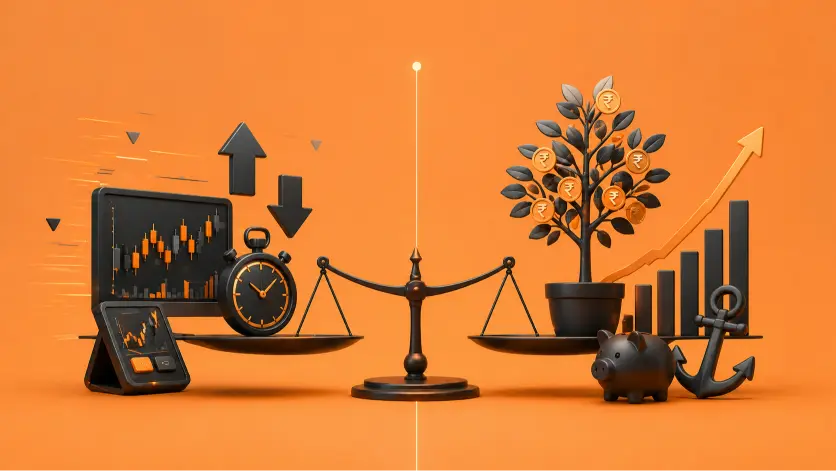
If you want a direct answer to trading vs investing which is more profitable, here it is: trading can generate faster returns, but investing creates more consistent wealth.
But that’s too simple. Let’s go deeper.
- Trading: Requires daily attention, high emotional control, quick decisions, and strict risk management.
- Investing: Requires patience, discipline, and the ability to ignore noise.
- Trading returns: Can be high but inconsistent; one bad trade can wipe weeks of gains.
- Investing returns: Typically 10–15% annually in India (Nifty average), but compounding does the heavy lifting.
- Tax impact: Trading profits taxed as business income or STCG (15%), investing LTCG only 10% after ₹1 lakh.
I once made ₹30,000 in a week trading Bank Nifty options. Felt unbeatable.
Next week? Lost ₹42,000.
And suddenly, I wasn’t so confident anymore.
That’s when I realized — the real game in trading vs investing which is more profitable isn’t about maximum returns. It’s about repeatable returns.
Lesson: If you can’t repeat it, it doesn’t count.
The Emotional Cost Nobody Talks About
Let’s be honest. When discussing trading vs investing which is more profitable, nobody talks about stress.
But they should.
Trading made me anxious. Constantly checking charts. Waking up early. Reacting to global markets.
And losses? They hurt more than gains felt good.
I remember holding a losing position, hoping it would bounce back. It didn’t.
That one mistake erased 10 days of profit.
Investing felt different.
I didn’t care about daily price movements. I focused on earnings, growth, and long-term trends.
Even during COVID crash, I held.
And that decision alone doubled my portfolio in the next 2 years.
So when someone asks me trading vs investing which is more profitable, I also ask — what kind of life do you want?
Because money isn’t the only cost.
Lesson: Peace of mind is part of your returns.
Myth-Busting: What People Get Completely Wrong
Let’s clear some common misconceptions around trading vs investing which is more profitable.
Myth 1: Trading is the fastest way to become rich
It can be. But for most people, it isn’t.
SEBI data shows that over 80–90% of retail traders lose money in derivatives.
Why? Because speed amplifies mistakes.
I’ve been there. Overconfidence, revenge trading, over-leverage.
Fast money cuts both ways.
Myth 2: Investing is too slow to matter
This one is dangerous.
Because compounding looks slow… until it doesn’t.
₹10,000/month at 12% CAGR becomes ~₹23 lakh in 10 years.
Stretch that to 20 years? ₹99 lakh.
No stress. No charts.
So when evaluating trading vs investing which is more profitable, don’t underestimate time.
Lesson: Slow growth becomes explosive if you let it run.
Where Tools and Strategy Actually Matter
Most people think tools will solve the trading vs investing which is more profitable debate. They won’t.
But they can help you execute better.
I experimented with different setups — screeners, alerts, even AI tools like Goela AI for research insights.
They improved decision-making. But they didn’t fix discipline.
On the investing side, something as simple as Automated Portfolio Rebalancing improved my returns by maintaining asset allocation during market swings.
Because strategy beats tools.
Always.
Lesson: Tools amplify your behavior, not replace it.
So… Trading vs Investing Which Is More Profitable?
Here’s the honest answer to trading vs investing which is more profitable: investing wins for most people, trading wins for a small disciplined minority.
And that minority? They treat trading like a business, not a shortcut.
They track every trade. Limit risk to 1–2%. Follow systems.
No guessing. No gambling.
I tried both seriously.
And I’ll be honest — investing made me richer.
Trading taught me discipline.
But it didn’t build my wealth.
That’s a hard truth.
Lesson: Choose what aligns with your behavior, not your ego.
What I Do Today (And What You Should Consider)
After years of testing trading vs investing which is more profitable, I stopped treating it like a competition.
I use both. But differently.
- 80% capital in long-term investments (index funds, large caps).
- 20% capital in trading (strict rules, limited risk).
- No emotional decisions. Everything predefined.
Because balance works.
Not extremes.
And that’s something I wish I understood earlier.
Lesson: You don’t need to pick sides — you need a system.
Practical Action Steps
If you’re still wondering trading vs investing which is more profitable, don’t overthink it. Start simple.
- Start with investing first — build a base portfolio using index funds or strong companies before risking money in trading.
- Allocate a small test capital for trading — treat it as learning money, not income expectation.
- Track everything — profits, losses, emotions, decisions. Data will reveal your truth faster than opinions.
Because clarity doesn’t come from thinking. It comes from doing.
FAQ
Is trading better than investing for beginners?
No, investing is better for beginners because it requires less timing and emotional control. Trading demands experience and discipline that most beginners lack.
Can I do both trading and investing together?
Yes, many investors combine both by allocating a larger portion to investing and a smaller portion to trading with strict risk management.
How much return can I expect from investing in India?
Historically, Nifty 50 has delivered around 10–12% CAGR over long periods, though actual returns depend on timing and asset selection.
Conclusion
I went into the market chasing speed. I stayed because of consistency.
And if you remember one thing tomorrow, let it be this — wealth is not built by the fastest strategy, but by the one you can stick to.