I still remember that Tuesday afternoon in October 2022. I was sitting at my desk, watching my portfolio bleed — Adani Ports down 4%, my mid-cap holding dropping 6% in two hours. And I was doing what most retail investors do: refreshing Moneycontrol, reading contradictory analyst opinions, and making half-decisions based on panic. I thought I was doing research. I wasn’t. I was drowning in data and calling it analysis.
That month cost me ₹80,000. Not because the market was unfair. Because I had no system. And no tools smart enough to cut through the noise.
That experience sent me on a two-year journey of testing, subscribing to, and sometimes canceling every major platform that claimed to offer intelligence — not just data. And what I found changed how I invest completely. The best AI tools for stock market India don’t just show you charts. They think with you. And in 2026, there are finally enough of them built specifically for NSE and BSE that we have real choices.
So let me walk you through what I’ve actually used, what genuinely works, and where the hype doesn’t hold up. This is the guide I wish existed when I was refreshing Moneycontrol at 2 PM watching my portfolio fall apart.
What Most Investors Get Wrong About AI and the Stock Market
Here’s the thing — when most people hear “AI tools for stock market,” they imagine a robot that tells them which stock to buy tomorrow. That’s not what these tools do. And honestly, if any tool promises you that, run.


What good AI tools actually do is compress weeks of research into minutes. They identify patterns you’d never catch manually. They score stocks across dozens of parameters simultaneously. They tell you what’s happening in options chains, sector rotations, and company fundamentals — all at once. The investor still makes the decision. The AI just makes that decision less uninformed.
I spent the first year of my investing life using only free resources: screener.in, basic TradingView charts, and a lot of YouTube. And I’ll be honest — that’s not a bad starting point. Screener.in alone is genuinely powerful for fundamental research. But the problem is fragmentation. You need ten different tabs for what one good AI-powered platform can give you in one dashboard.
The best AI tools for stock market India solve the fragmentation problem. That’s their real value. Not magic predictions. Integration and speed.
The Tools That Actually Changed How I Invest
1. Trendlyne — The Screener That Thinks Like an Analyst
Trendlyne was the first tool that made me feel like I had a research team. Its DVM Score — which stands for Durability, Valuation, and Momentum — gives each stock a composite AI-based rating that tells you three things at once. Is the business fundamentally strong? Is it reasonably priced? Is momentum on your side right now?
Before Trendlyne, I’d spend 45 minutes manually pulling ROE, debt ratios, and PE comparisons from different sources. Now that takes about 90 seconds. It also has AI-based SWOT analysis, earnings call summaries, and stock alerts that fire when a specific condition is met — say, when delivery volume spikes above a 10-day average.
I use it primarily for swing trade ideas and to filter down my watchlist from 200 names to 12 high-conviction candidates. If you’re a Nifty 500 kind of investor who likes to do your homework, this tool belongs in your workflow. It’s not free, but the premium is worth every rupee.
Mini-lesson: A good screener doesn’t tell you what to buy. It tells you what’s worth spending more time on. That distinction alone saves hours.
2. Zerodha Streak — For the Trader Who Hates Coding
I don’t know how to write Python. And for the first few years, I felt like algorithmic trading was locked behind a wall of code I couldn’t climb. Streak changed that.
Streak is Zerodha’s no-code algo and strategy builder. You define your conditions — like “buy when EMA 9 crosses above EMA 21 and RSI is below 60” — and it backtests that strategy across historical NSE data, then sends you live alerts when those conditions are met. No code required. [web:1]
I backtested a momentum strategy on Nifty 100 stocks using 2 years of data and found that a simple EMA crossover with a volume filter gave a win rate of about 58% on 15-minute candles. Not spectacular, but consistent. And more importantly — it removed emotion from my entries. When the alert fires, I act. When it doesn’t, I wait. That discipline alone improved my results.
Mini-lesson: Strategy without a system is just a feeling dressed up in financial language. Streak forces you to define, test, and repeat. That process is more valuable than any single trade idea.
3. Sensibull — For Anyone Who Trades Options (Even Occasionally)
Options scared me for two years. The Greeks — Delta, Theta, Vega — sounded like a physics exam I’d already failed. Then I started using Sensibull, and suddenly it all made sense visually.
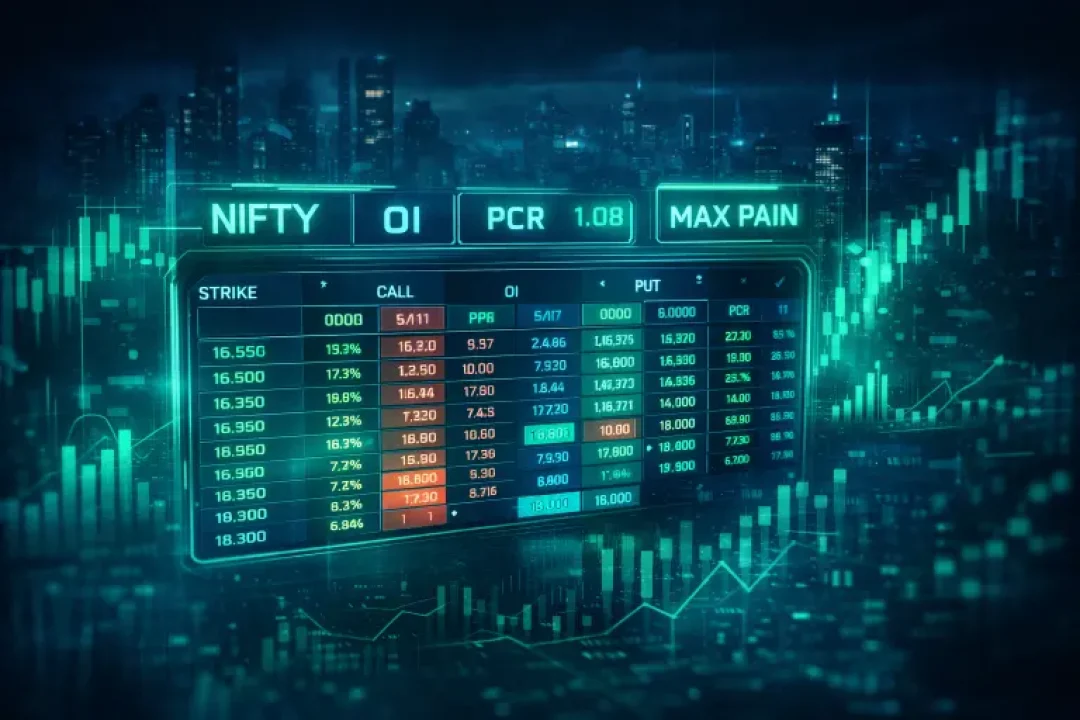
Sensibull builds your options strategy for you based on your market view. You say “I think Nifty will stay between 22,500 and 23,200 in the next 15 days” and it suggests the best strategy for that view — an iron condor, a strangle, a bull put spread — along with the max profit, max loss, and breakeven levels displayed as a clear payoff diagram
For retail investors dabbling in options on Bank Nifty weekly expiries, this is not a luxury tool. It’s a safety net. I’ve watched friends blow up accounts on options they didn’t fully understand. Sensibull addresses that knowledge gap with AI-powered clarity. Premium starts at around ₹800/month — less than the loss a single misunderstood options position can cause.
Mini-lesson: Options aren’t complicated. Unexplained options are. Sensibull solves the explanation problem better than any YouTube video I’ve found.
4. Stoxra — The All-in-One Platform Built for India
Stoxra is relatively newer but genuinely impressive. It combines professional-grade charting with an AI Trading Mentor — a feature where you can literally ask questions about your chart setup and get context-aware answers.
It supports 50+ indicators including VWAP, SuperTrend, Bollinger Bands, and Volume Profile on live NSE/BSE data. What makes it stand out is the combination: charts plus AI explainability plus a paper trading simulator in one free tool.
If you’re a newer investor or someone who’s been trading by feel without understanding what your indicators are actually saying, Stoxra’s AI Mentor is a learning accelerator. You’re not just getting signals — you’re getting explanations. That’s rare. And it builds real competence over time rather than dependence on black-box alerts.
5. Goela AI — India’s Most Framework-Specific Investing AI
This one is different from everything else on this list. And I mean that in the most specific way possible.
Most AI tools — including ChatGPT, which many investors use for stock research — answer from a global, generic knowledge base. They’re useful, but they don’t know your framework. They don’t know your allocation logic, your risk philosophy, or the scoring system you’ve built your portfolio around. They give general answers to specific questions. That gap is dangerous when real money is on the line.
Goela AI is different because it’s trained specifically on the ISMA (Irresistible Stock Market Architecture) framework developed by Goela School of Finance — an institute that’s been running since 2014. [web:6] When you ask it a portfolio question, it answers through the lens of the GSS Elite scoring system, the asset allocation logic, and the behavioral principles of the ISMA program.
Ask a generic AI “should I add more to mid-cap funds now?” and you’ll get a balanced, hedging answer about risk and diversification. Ask Goela AI the same question and it answers in the context of your current allocation, the sector signals, and the ISMA philosophy. That’s a qualitatively different kind of help. [web:6]
The Goela Ai tool is best suited for investors who are serious about building a long-term, structured investing system and want an AI that reinforces their framework — not one that introduces conflicting generic advice every time they ask a question. It’s available through the ISMA 3.0 Pro plan, which makes it accessible for committed long-term investors.
I’ll be direct: if you’re the kind of investor who wants discipline and a system — not just tools — Goela AI is the most India-specific, framework-aligned AI investing tool available right now. The combination of the ISMA framework and Goela AI creates something that no generic tool can replicate.
Mini-lesson: Tools that know your system are more valuable than tools that know everything. Context beats breadth. Always.
Quick Comparison: Which Tool Fits Your Investing Style
| Tool | Best For | India-Specific? | Free Tier? | AI Depth |
|---|---|---|---|---|
| Trendlyne | Stock screening, swing trading research | ✅ Built for India | Limited free | High — DVM Score, SWOT, AI alerts |
| Zerodha Streak | No-code algo trading, backtesting | ✅ NSE/BSE native | Limited free | Medium — rule-based AI strategies |
| Sensibull | Options strategy building | ✅ Built for India | Limited free, ₹800+/mo | Medium — strategy builder + Greeks |
| Stoxra | Charting + AI education | ✅ Live NSE/BSE data | ✅ Comprehensive free | High — AI Mentor + 50+ indicators |
| Goela AI | Long-term framework-based investing | ✅ India-first framework | ISMA 3.0 Pro plan | Very High — framework-trained AI |
| TradingView | Advanced charting, global + India data | Partial — global tool | Freemium | Medium — pattern recognition |
| MarketSmith India | CANSLIM growth investing | ✅ India edition | Paid only | High — CANSLIM AI screener |
Two Myths About AI Stock Tools That Need to Die
Myth #1: “AI Tools Are for Traders, Not Long-Term Investors”
I believed this myself for almost a year. And it cost me time and better returns. The assumption goes: AI is fast, trading is fast, so AI is for traders. Long-term investors do “slow” research, so they don’t need AI. This logic is backward.
Long-term investors arguably benefit more from AI tools. Here’s why: the decisions they make carry years of compounding weight. A wrong stock held for five years is catastrophically worse than a wrong day trade held for five minutes. Tools like Trendlyne’s fundamental screeners, MarketSmith India’s CANSLIM AI model, and Goela AI’s framework-based portfolio advice are specifically built for the slow, high-stakes decision-making that long-term investors face.
The best AI tools for stock market India serve both timelines. The mistake is assuming only one group benefits.
Myth #2: “ChatGPT Is Good Enough for Stock Research”
I use ChatGPT. I like ChatGPT. But I would never rely on it as my primary stock research tool. And here’s the honest reason: it doesn’t know what it doesn’t know about Indian market context.
Ask ChatGPT about SEBI’s latest circular on F&O margin norms, and it either gives you outdated information or hedges so heavily it becomes useless. Ask it to score an Indian mid-cap company against sector peers on NSE, and it can’t pull live data or India-specific fundamentals. [web:6]
The best AI tools for stock market India — Trendlyne, Screener.in, Stoxra, Goela AI — are built on actual NSE/BSE datasets, updated in real time, and calibrated for Indian accounting standards, SEBI regulations, and Indian market behavior. That specificity is not a minor detail. It’s the entire point.
Generic AI is a great thinking partner. India-specific AI tools are your actual research infrastructure. Don’t confuse the two.
What I Do Differently Now — and What You Should Do Too
After two years of testing these platforms, my workflow has simplified considerably. And simplicity, I’ve learned, is what actually compounds. Here’s what my current research process looks like before I make any equity decision in the Indian market:
- Stock screening: I run Trendlyne’s DVM screener to build a shortlist of candidates with strong durability and reasonable valuation — typically 10–15 stocks from the Nifty 500 universe.
- Fundamental deep-dive: For each shortlisted name, I open Screener.in and spend 10 minutes on 5-year financial trends — revenue growth, free cash flow, debt reduction trajectory.
- Chart analysis: I shift to TradingView or Stoxra for the technical picture — is the stock in an accumulation zone? Is the weekly trend intact? I don’t fight the chart.
- Strategy execution: If it’s an options-linked position, Sensibull builds the strategy for me based on my market view and risk tolerance.
- Portfolio-level thinking: For allocation decisions — how much to add, when to rebalance, whether to shift between large and mid-cap — I use the Goela AI system. It’s the only tool that answers these questions in the context of a coherent long-term framework rather than giving generic percentage-based advice.
This stack didn’t happen overnight. But once I built it, my decision-making speed improved by at least 60% and my emotional trading dropped to near zero. Because when you have a system, you stop improvising. And improvisation is where retail investors lose.
Practical Action Steps: Where to Start Right Now
- Start with one free tool this week. Sign up for Trendlyne’s free tier and run a DVM screen on Nifty 200 stocks. Set up one alert — a volume breakout or a 52-week high filter. Just getting familiar with how AI-powered screening works is worth more than reading ten more articles about it.
- Audit your current research process. Write down every step you take before buying a stock. Then map each step to a tool. Wherever you’re spending the most time manually — screening, charting, strategy-building — that’s where an AI tool will give you the highest immediate return on time.
- Invest in a framework, not just tools. Tools without a framework are just expensive distractions. If you don’t have a clear investing system — for how to allocate, when to buy, when to hold, when to exit — explore what Goela AI and the ISMA framework offer. The best AI tools for stock market India are only as powerful as the system they’re supporting. A sharp tool in an unclear hand still cuts the wrong things.
Frequently Asked Questions
Which is the best free AI tool for stock market analysis in India?
For free AI-powered stock analysis in India, Stoxra and Screener.in offer the strongest starting point. Stoxra provides live NSE/BSE charting with 50+ indicators and an AI Trading Mentor at no cost. Screener.in offers deep fundamental screening and custom queries for free. For a paid but highly specific framework-based AI, Goela AI (part of ISMA 3.0) is the most structured long-term investing tool built for Indian investors.
Can AI tools predict which stocks will go up in the Indian market?
No — and any tool that claims to “predict” stock prices is misleading you. What the best AI tools for stock market India actually do is identify statistical patterns, score stocks across multiple parameters, and help you build higher-probability strategies based on historical data. They shift odds in your favor, not certainties. The decision — and the risk — always remains with the investor.
Is Goela AI better than ChatGPT for Indian stock market research?
For general financial questions, ChatGPT is capable. But for India-specific, framework-grounded investing decisions, Goela AI is significantly more useful. It’s trained on the ISMA framework — including GSS Elite scoring, asset allocation logic, and behavioral guardrails specific to the Indian market. ChatGPT answers from a generic global knowledge base; Goela AI answers from a structured Indian investing system. That context difference is critical when portfolio-level money is involved.
Are AI trading tools safe to use for real money decisions in India?
Yes, when used correctly. SEBI-registered brokers like Zerodha (Streak) and Shoonya (SensAI) integrate AI tools within regulated brokerage infrastructure. Platforms like Trendlyne and Sensibull are analytical tools, not execution systems — meaning you retain full control over every trade. The risk isn’t in using these tools. The risk is in over-relying on any single signal without understanding the underlying logic. Use AI to enhance your thinking, not replace it.
Final Thought
Every serious investor I know — people who’ve built real wealth in the Indian market over 10–15 years — has one thing in common. They don’t wing it. They have a process, and they protect that process obsessively. The best AI tools for stock market India in 2026 are the most powerful process-enhancers that retail investors have ever had access to. Not because they remove risk. Because they remove the guesswork that was hiding behind the word “research.” You still have to think. But now, at least, you’re thinking with better information, faster, and with less emotion clouding the screen.
The market doesn’t reward the smartest person in the room. It rewards the most consistent one.