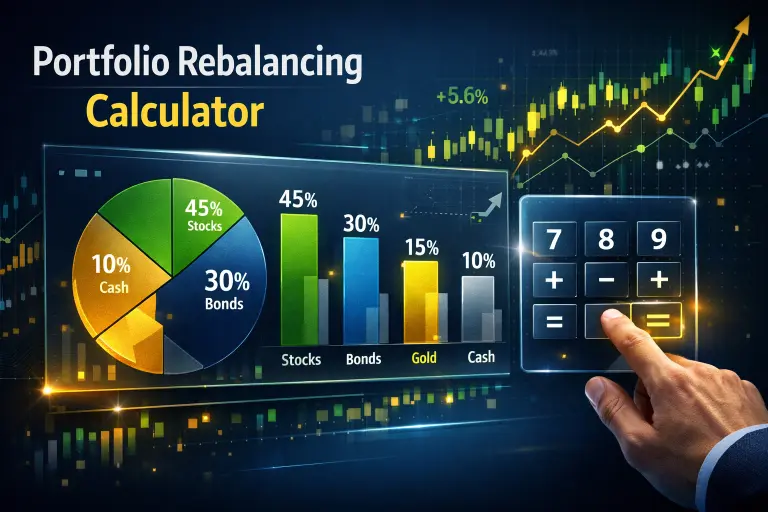
Investing in the stock market is one of the most powerful ways to build long-term wealth — but only if you manage your portfolio intelligently. That’s where a Portfolio Rebalancing Calculator becomes your best financial companion. Whether you’re a beginner just stepping into the world of equities or a seasoned investor managing a diversified portfolio, understanding how to rebalance and why it matters can make a dramatic difference in your returns.
In this guide, we’ll walk you through the types of stocks, their roles in the market, and how using a Portfolio Rebalancing Calculator regularly keeps your investments aligned with your goals.
What Is a Portfolio Rebalancing Calculator?
A Portfolio Rebalancing Calculator is a digital tool that helps investors determine when and how to realign their portfolio back to its original — or desired — asset allocation. Over time, some assets grow faster than others, causing your portfolio to drift from its intended structure. For example, if you allocated 60% to equities and 40% to bonds, a bull market might push equities to 75%, increasing your risk exposure without you even realizing it.
A Portfolio Rebalancing Calculator takes the guesswork out of this process. You input your current holdings, target allocations, and the tool instantly shows you what to buy, sell, or hold to restore balance. It’s not just a convenience — it’s a disciplined strategy that protects your wealth over the long term.
Why Stocks Are the Heart of Every Portfolio
Before we dive deeper into how a Portfolio Rebalancing Calculator works, it’s essential to understand what stocks actually are and why they occupy such a central place in most investment portfolios.


A stock represents a fractional ownership in a company. When you buy a share of Reliance Industries or Infosys, you’re purchasing a small piece of that business. As the company grows and earns profits, your stock value appreciates. This is why equities have historically delivered the highest returns of any asset class over the long run — and also why they carry the most volatility.
Stocks are traded on exchanges like the NSE (National Stock Exchange) and BSE (Bombay Stock Exchange) in India, where millions of transactions happen every second. The stock market is a living, breathing ecosystem of opportunity — and managing your exposure to it requires tools like a Portfolio Rebalancing Calculator to stay on track.
Types of Stocks Every Investor Should Know
Understanding the different types of stocks is fundamental to making smart allocation decisions — and to using a Portfolio Rebalancing Calculator effectively.
Common Stocks vs. Preferred Stocks
Common stocks are the most widely traded type of equity. They give shareholders voting rights and the potential for capital appreciation and dividends. Most retail investors hold common stocks.
Preferred stocks, on the other hand, offer fixed dividend payments and have priority over common stockholders in the event of liquidation. They behave more like bonds and are preferred by income-focused investors.
Growth Stocks
Growth stocks belong to companies expected to grow at an above-average rate compared to the overall market. Think of companies like Zomato or Paytm in India during their early public phases. These stocks typically don’t pay dividends — profits are reinvested into the business. They’re high-reward but high-risk, and a Portfolio Rebalancing Calculator helps you keep your exposure to growth stocks within a healthy limit.
Value Stocks
Value stocks are shares that appear to be trading below their intrinsic value — they’re essentially “on sale.” Investors like Warren Buffett have built empires by identifying and holding value stocks. These companies are often mature, stable, and overlooked by the market. They’re a great stabilizing force in a diversified portfolio.
Dividend Stocks (Income Stocks)
Dividend stocks, also called income stocks, pay out regular dividends to shareholders. They’re common in sectors like utilities, real estate, energy, and financial services. For conservative Indian investors — especially retirees — dividend-paying stocks form a critical part of their holdings. A Portfolio Rebalancing Calculator ensures you’re not over-relying on any single dividend stock and that your income-generating assets remain proportionate to your risk tolerance.
Blue-Chip Stocks
Blue-chip stocks are issued by well-established, financially sound companies with a long history of stable earnings and strong market presence. In India, companies like TCS, HDFC Bank, and ITC are considered blue-chip stocks. They form the backbone of any stable portfolio and are ideal for long-term investors who prioritize safety over aggressive growth. Running these through a Portfolio Rebalancing Calculator helps determine whether your safe holdings are still proportionately weighted.
Small-Cap, Mid-Cap, and Large-Cap Stocks
Stocks are also categorized by market capitalization — the total market value of a company’s outstanding shares.
- Large-cap stocks (₹20,000 crore+ market cap in India) are stable, reliable, and less volatile.
- Mid-cap stocks offer a balance of growth and risk, ideal for investors willing to take moderate chances.
- Small-cap stocks are issued by smaller companies with high growth potential but significantly higher risk.
Using a Portfolio Rebalancing Calculator regularly is especially critical when your portfolio has a mix of these three. Small-caps can skyrocket during bull runs, quickly distorting your allocation ratios.
Cyclical vs. Defensive Stocks
Cyclical stocks — like auto, real estate, and consumer durables — perform well when the economy is booming and decline during recessions. Defensive stocks — like pharma, FMCG, and utilities — remain relatively stable regardless of economic conditions.
Balancing between cyclical and defensive positions is a fine art, and one that a Portfolio Rebalancing Calculator simplifies enormously.
The Role of Asset Allocation in Portfolio Health
Asset allocation is the strategy of dividing your investment across different asset categories — stocks, bonds, gold, real estate, and cash. The right allocation depends on your age, risk tolerance, and financial goals.
A classic rule of thumb says: subtract your age from 100, and that’s the percentage you should hold in equities. A 30-year-old, for instance, might hold 70% stocks and 30% bonds. But markets move constantly, and within weeks, that ratio can shift meaningfully.
This is exactly why a Portfolio Rebalancing Calculator is indispensable. It keeps you honest. It removes emotion from investment decisions. And it ensures your portfolio always reflects your strategy — not the market’s whims.
How to Use a Portfolio Rebalancing Calculator: Step-by-Step
Using a Portfolio Rebalancing Calculator is simpler than most investors think. Here’s a straightforward process to follow:
- List your current holdings — Include all equity, debt, gold, and cash positions with their current market values.
- Input your target allocation — For example: 60% equity, 25% debt, 10% gold, 5% cash.
- Run the calculation — The Portfolio Rebalancing Calculator will show the percentage deviation from your targets.
- Act on the recommendations — Buy underweighted assets and/or sell overweighted ones.
- Set a rebalancing schedule — Most advisors recommend quarterly or semi-annual rebalancing.
The beauty of a Portfolio Rebalancing Calculator is that it removes subjective judgment from the process. You’re no longer guessing — you’re following a data-driven roadmap.
When Should You Rebalance?
There are two main approaches to deciding when to rebalance:
Time-based rebalancing — You review your portfolio at fixed intervals (monthly, quarterly, annually) and use a Portfolio Rebalancing Calculator to assess drift.
Threshold-based rebalancing — You set a tolerance band (e.g., ±5% from your target allocation). When any asset class crosses this threshold, you rebalance immediately.
Many modern investors combine both strategies. They check allocations quarterly using a Portfolio Rebalancing Calculator but also monitor for sudden market events that could push a single asset class dramatically out of range.
The Tax Angle: Rebalancing Smartly in India
In India, selling equities within one year of purchase attracts Short-Term Capital Gains (STCG) tax at 15%, while gains held longer than a year are taxed at 10% beyond ₹1 lakh (LTCG). This makes strategic rebalancing even more important.
A smart Portfolio Rebalancing Calculator that accounts for tax implications can save you thousands of rupees annually. Rather than always selling to rebalance, you can also redirect fresh investments into underweight asset classes — a method known as “cash-flow rebalancing” — which avoids triggering capital gains tax altogether.
Rebalancing Tool Recommendation: Features to Look For
Not every online calculator is created equal. When choosing a Rebalancing Tool, look for these key features:
- Multi-asset support — Can it handle equity, debt, gold, and international funds together?
- Tax sensitivity — Does it factor in STCG and LTCG implications?
- Goal alignment — Can you set different allocations for different financial goals (retirement, child’s education, etc.)?
- Automatic alerts — Does it notify you when your portfolio drifts beyond your threshold?
- Historical simulation — Can it show you how rebalancing would have affected your returns historically?
Popular platforms in India offering portfolio rebalancing features include Zerodha Coin, Kuvera, Scripbox, and INDmoney. Pairing these with a dedicated Portfolio Rebalancing Calculator gives you a complete, professional-grade system.
The Psychological Benefit of Rebalancing
Beyond mathematics, there’s a deeply human reason why a Portfolio Rebalancing Calculator is valuable: it fights against our worst investing instincts.
When markets are soaring, we’re tempted to pour everything into equities. When markets crash, fear pushes us to sell everything and hide in cash. A Portfolio Rebalancing Calculator counters both impulses. It forces you to sell high (trim the overperformers) and buy low (top up the underperformers) — which is exactly what legendary investors do, but which most ordinary investors struggle with emotionally.
Discipline, built around a Portfolio Rebalancing Calculator, is what separates long-term wealth builders from short-term market chasers.
Expanding Your Knowledge: Learn Stock Market Fundamentals
If you’re serious about investing, using a calculator alone isn’t enough. You need a solid educational foundation to make confident, informed decisions. Here’s how Indian investors can fast-track their learning:
Attend a Stock Market Free Webinar
One of the best ways to start is by attending a stock market free webinar. Many SEBI-registered advisors, brokerages, and financial platforms host live webinars that cover everything from understanding stock types to building a rebalancing strategy. Platforms like Goela school finances , Groww, and Angel One regularly host free online sessions, making investing education accessible to anyone with a smartphone and an internet connection.
Common Rebalancing Mistakes to Avoid
Even experienced investors make mistakes when rebalancing. Here are the most common ones — and how a Portfolio Rebalancing Calculator helps you avoid them:
- Over-rebalancing — Trading too frequently racks up transaction costs and tax liabilities. Use the calculator to determine if the drift actually warrants action.
- Ignoring transaction costs — Even small brokerage fees add up. A good Portfolio Rebalancing Calculator factors in net-of-cost returns.
- Emotional selling — Panic-selling during corrections destroys long-term returns. Stick to your calculator’s data-driven output.
- Ignoring new contributions — Fresh investments can be directed toward underweight assets instead of triggering a taxable rebalance event.
- One-size-fits-all allocation — Your allocation should evolve with your life stage. Revisit your target percentages annually.
Conclusion: Let the Numbers Guide You
The stock market rewards those who are patient, disciplined, and strategic. Understanding the types of stocks — from blue-chip giants to high-risk small-caps, from steady dividend payers to explosive growth stocks — is the first step toward becoming a confident investor.
The next step is protecting the portfolio you’ve built. A Portfolio Rebalancing Calculator is not just a tool — it’s a financial discipline system. It ensures that your hard-earned money is always working within the risk parameters you’ve set, regardless of what the markets are doing.
Whether you’re just starting out by attending a stock market free webinar, signing up for one of the Top 5 Online Stock Market Courses in India, or refining an advanced multi-asset strategy using a Rebalancing Tool, the goal remains the same: build wealth steadily, protect it intelligently, and let compounding do its magic over time.
Make the Portfolio Rebalancing Calculator a non-negotiable part of your investment routine. Your future self will thank you.