Investing is not only about picking good stocks. It is also about maintaining the right mix of assets as markets move over time. That is exactly What portfolio rebalancing means for every investor who wants to build wealth without taking unintended risk.
Many people start with a clear investment plan, but their portfolio slowly changes as some assets rise faster than others. A few winning stocks can begin to dominate the entire portfolio, while safer assets shrink in proportion. Understanding What portfolio rebalancing means helps investors protect gains, manage risk, and keep their money aligned with long-term goals.
Understanding the Core Idea
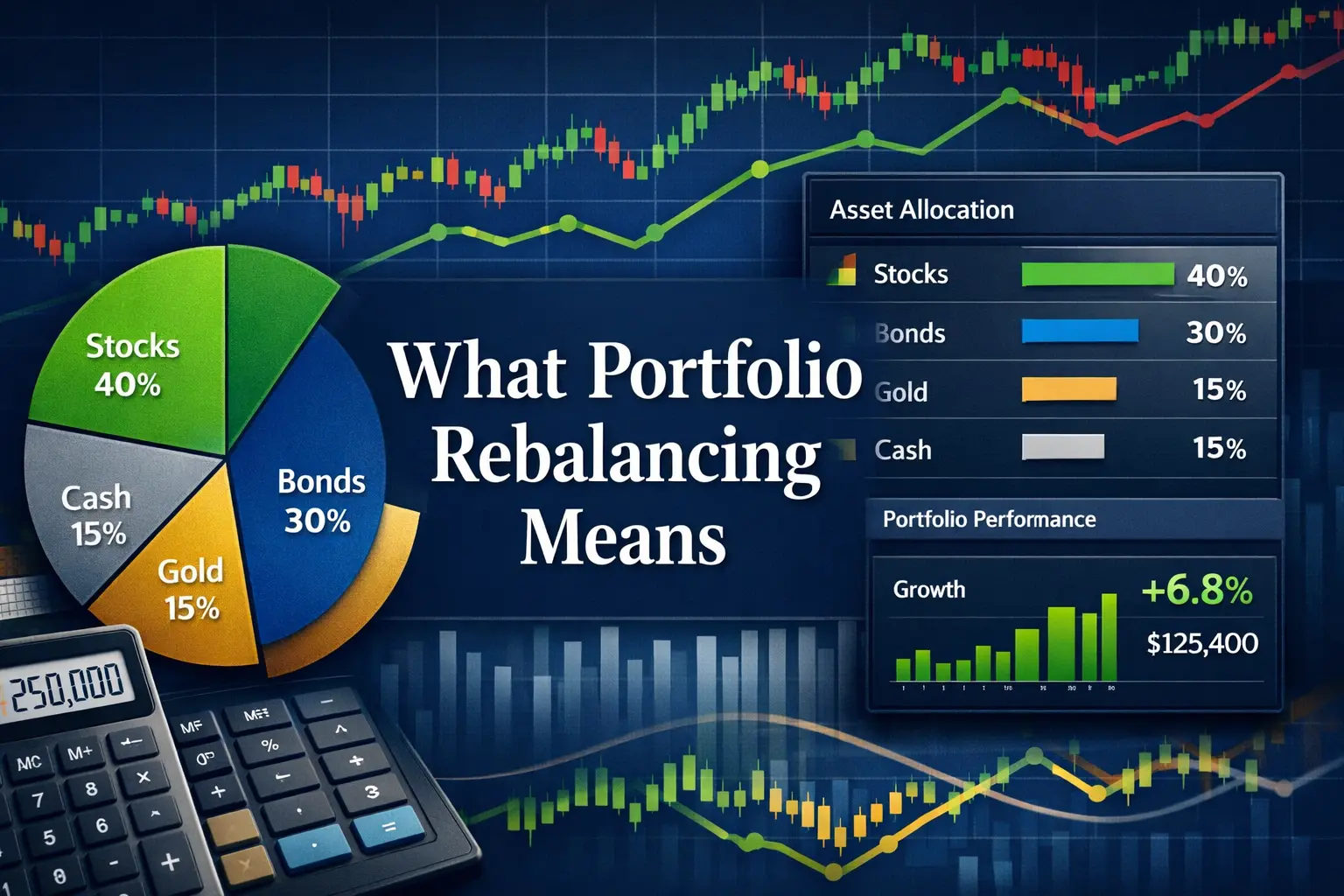
At its simplest, What portfolio rebalancing means is bringing your investment portfolio back to its original or desired asset allocation. If you planned to keep 60% in stocks, 25% in bonds, 10% in gold, and 5% in cash, market movements can disturb that balance. Rebalancing is the process of restoring that structure.
This matters because every asset class behaves differently. Stocks may rally strongly in one phase, while bonds may remain stable and gold may act as a hedge during uncertainty. Learning What portfolio rebalancing means allows investors to stay disciplined rather than getting carried away by market momentum.
Why Rebalancing Matters in the Stock Market
The stock market rewards growth, but it also creates imbalance. When equity prices surge, the share of stocks in your portfolio naturally becomes larger. That may sound positive at first, but it can expose you to more volatility than you originally intended.


This is one of the key reasons What portfolio rebalancing means is so important. Rebalancing forces investors to review their risk, not just their returns. It creates structure in a market environment where emotions often lead to poor decisions.
A disciplined investor does not simply chase what is rising. Instead, they use a framework that keeps each asset in its proper role. That is the practical side of What portfolio rebalancing means in real-world investing.
The Main Assets in a Portfolio
A diversified portfolio is built from different types of assets, each with a specific purpose. To fully understand What portfolio rebalancing means, you need to know how these assets function inside an investment strategy.
Stocks
Stocks represent ownership in a company. When you buy shares, you participate in the company’s growth, profitability, and market value. Stocks are usually the engine of long-term wealth creation, which is why they hold such an important place in most portfolios.
However, stocks also bring higher volatility than most other assets. Their prices can rise sharply and fall just as quickly. This is why What portfolio rebalancing means becomes especially relevant for stock-heavy portfolios, where sudden gains or losses can dramatically alter allocation.
Bonds
Bonds are debt instruments issued by governments or companies to raise money. In return, investors receive periodic interest and the repayment of principal at maturity. Bonds usually offer lower returns than stocks, but they also tend to reduce portfolio volatility.
In a balanced investment plan, bonds often act as a stabilizer. They help cushion the impact of stock market corrections. When investors study What portfolio rebalancing means, they quickly realize that bonds are not there to outperform equities every year. Their job is to add balance and predictability.
Gold
Gold has long been considered a defensive asset. It often gains attention during inflation, currency weakness, or geopolitical stress. While gold does not produce income like dividends or interest, it can provide protection during uncertain periods.
Because gold behaves differently from stocks, it can improve diversification. That is another layer of What portfolio rebalancing means: keeping alternative assets like gold in their intended proportion so the portfolio remains resilient.
Cash and Cash Equivalents
Cash, savings instruments, and liquid funds may seem unexciting, but they serve an important purpose. They provide flexibility, preserve capital, and help investors seize opportunities when markets fall.
Many investors ignore cash in rising markets because it feels unproductive. Yet a good allocation recognizes that safety and liquidity matter too. In practice, What portfolio rebalancing means includes making sure cash is not neglected when aggressive assets dominate.
Types of Stocks and Their Roles
Since your article focuses strongly on stock market education, it is important to explain that not all stocks serve the same purpose. A diversified equity portfolio often includes several categories of stocks, each contributing differently to return and risk. Understanding these categories deepens your understanding of What portfolio rebalancing means.
Large-Cap Stocks
Large-cap stocks belong to well-established companies with strong financial strength, broad market presence, and relatively stable performance. These companies are often leaders in their sectors and are commonly seen as safer than smaller firms.
In a portfolio, large-cap stocks provide a core foundation. They may not always deliver explosive growth, but they usually offer consistency and resilience. Rebalancing ensures they do not get pushed aside by more speculative holdings.
Mid-Cap Stocks
Mid-cap stocks sit between stability and growth. These companies are often in an expansion phase, with more room to grow than large firms but lower uncertainty than small ones.
Investors often use mid-cap stocks to increase long-term return potential. At the same time, they can be more volatile than large-cap names. This is where What portfolio rebalancing means becomes useful, because mid-caps can quickly become overweight after strong rallies.
Small-Cap Stocks
Small-cap stocks are shares of smaller companies that may still be developing their business model, market share, or industry position. They can generate substantial gains, but they also carry elevated risk.
A portfolio overloaded with small-caps can become unstable during corrections. Rebalancing helps keep these high-growth assets from overtaking the entire strategy. That is a clear example of What portfolio rebalancing means in action.
Growth Stocks
Growth stocks belong to companies expected to increase revenue and earnings faster than the broader market. These stocks often trade at higher valuations because investors expect strong future expansion.
Growth stocks can be powerful wealth builders, especially over long periods. But if they rise too quickly, they can distort a portfolio’s risk profile. A thoughtful investor understands What portfolio rebalancing means by trimming excess exposure when growth stocks become too dominant.
Value Stocks
Value stocks are companies that appear undervalued relative to their earnings, assets, or business fundamentals. They are often mature firms trading at lower valuation multiples.
Value stocks can provide stability and may perform well when market sentiment shifts away from expensive growth names. Their role in rebalancing is important because they help diversify the style exposure of a stock portfolio.
Dividend Stocks
Dividend stocks distribute a portion of profits to shareholders at regular intervals. They are popular with income-focused investors who want a blend of return and cash flow.
These stocks are often found in sectors like banking, utilities, energy, and consumer goods. They can anchor a portfolio, especially during uncertain periods. As part of What portfolio rebalancing means, dividend-paying stocks help investors maintain an income-producing layer inside their portfolio.
How Portfolio Drift Happens
Portfolio drift occurs when the actual allocation of your investments moves away from your target allocation. This happens naturally because assets do not deliver equal returns. If equities rise sharply while bonds remain flat, the weight of equities increases automatically.
That drift may look harmless, but it changes the character of your portfolio. A plan designed for moderate risk can quietly become aggressive. Recognizing this drift is central to What portfolio rebalancing means, because rebalancing is the corrective step that restores alignment.
For example, imagine an investor who starts with 50% stocks and 50% bonds. After a prolonged bull market, stocks may grow enough to become 65% of the portfolio. The investor is now carrying far more equity risk than originally planned, even if no new stock purchases were made.
Common Ways to Rebalance
There is no single method that suits every investor. Still, most rebalancing strategies fall into a few simple approaches.
Time-Based Rebalancing
This method involves reviewing the portfolio at fixed intervals, such as quarterly, half-yearly, or annually. It is simple, structured, and easy to follow. Many long-term investors prefer it because it avoids constant monitoring.
Threshold-Based Rebalancing
In this method, you rebalance only when an asset class moves beyond a specific limit. For example, if stocks rise 5% above their target weight, you adjust the portfolio. This approach is more responsive to market conditions.
Cash-Flow Rebalancing
Instead of selling existing holdings, investors can direct fresh contributions toward underweighted assets. This method is useful because it can reduce taxes and transaction costs. A Portfolio Rebalancing Calculator can make this process easier by showing where new money should go.
Each of these approaches reflects What portfolio rebalancing means in a practical sense: restoring the portfolio without abandoning the original strategy.
The Benefits of Rebalancing
Rebalancing offers several important advantages beyond simple neatness. First, it keeps your risk level aligned with your investment goals. Second, it promotes discipline by making you follow a plan rather than emotions.
Third, rebalancing often leads investors to sell a portion of assets that have risen sharply and add to assets that have lagged. This naturally encourages buying low and selling high, which sounds simple but is emotionally difficult in real life. That behavioral advantage is a major part of What portfolio rebalancing means.
It also helps investors maintain diversification. Without rebalancing, portfolios tend to become concentrated in whatever has recently performed best. Over time, that concentration can raise both risk and vulnerability.
Mistakes Investors Make
Many investors misunderstand rebalancing or avoid it altogether. Some assume that a portfolio should be left untouched forever. Others check it too often and overtrade, creating unnecessary costs.
Another common mistake is focusing only on returns while ignoring risk. A portfolio that has grown quickly is not always healthier. Sometimes growth itself creates imbalance. This is why understanding What portfolio rebalancing means is more valuable than simply watching account size.
Some people also rebalance emotionally, selling during panic rather than according to allocation targets. Real rebalancing is strategic, not reactive. It follows a plan, not a headline.
Rebalancing and Investor Psychology
The emotional side of investing is often underestimated. When stocks surge, investors feel confident and want more exposure. When markets fall, fear makes them want to reduce risk at exactly the wrong time.
Rebalancing helps counter these instincts. It builds a rule-based habit that prevents extremes. In many ways, What portfolio rebalancing means is not just about percentages on a screen. It is about creating a system that keeps your behavior rational when markets become emotional.
This psychological discipline is one of the main reasons successful long-term investors stay consistent. They do not rely on mood, hype, or panic. They rely on process.
Who Should Rebalance?
Almost every investor with more than one asset class should think about rebalancing. It is useful for beginners, long-term wealth builders, retirees, and even experienced market participants. If your portfolio contains different assets with different roles, their weights will eventually shift.
That means What portfolio rebalancing means is relevant to nearly everyone, not just professional fund managers. Whether you invest in individual stocks, mutual funds, ETFs, bonds, or gold, portfolio maintenance is part of responsible investing.
Even younger investors with high equity exposure benefit from periodic review. Rebalancing does not mean becoming conservative. It means staying intentional.
Learning More About Market Discipline
Investors who want to improve their strategy should not stop at basic definitions. Reading, practice, and ongoing market education can sharpen judgment over time. Attending a stock market free webinar is one simple way to understand asset allocation, risk, and long-term portfolio management in a more practical format.
The more you learn about investing behavior, asset roles, and allocation discipline, the easier it becomes to apply these ideas consistently. That is especially true once you understand What portfolio rebalancing means not as a one-time action, but as an ongoing habit.
Conclusion
In the end, What portfolio rebalancing means is restoring your portfolio to the asset mix that matches your goals, time horizon, and risk tolerance. It is a simple idea, but it has powerful effects on discipline, diversification, and long-term portfolio health.
Stocks remain essential for growth, but they should work alongside other assets that bring stability, income, protection, and liquidity. Large-cap, mid-cap, small-cap, growth, value, and dividend stocks all have different roles in a portfolio. Understanding What portfolio rebalancing means helps investors use these assets wisely instead of letting market movements decide their strategy.
The best portfolios are not built only by choosing good investments. They are also maintained with patience, structure, and consistency. That is ultimately What portfolio rebalancing means for anyone who wants to invest with clarity and confidence.